
In Carolingian manuscripts with miniatures, we regularly encounter depictions of writing figures — such as monks, notaries, or evangelists. These representations provide valuable insight into the various types of furniture specifically designed for writing. Broadly speaking, these pieces of furniture can be divided into two categories: lecterns and writing desks.
However, the use of iconographic sources presents the challenge that it can sometimes be difficult to distinguish between originally Carolingian elements and elements adopted from the Byzantine tradition. Archaeological evidence that could supplement these representations is unfortunately scarce. This is presumably due to the fact that such pieces of furniture were generally made of wood and therefore have rarely survived.
Lecterns
Based on their design, lecterns can broadly be divided into two subcategories:
Group 1
Lecterns with a decorated central post, placed on a tripod as a stand. Both the post and the legs are often richly decorated.

820-830 AD, Hautvillers, FR

780-783 AD, Aken, DU
Group 2
Lecterns with a similarly decorated post, but with a square or round base as the foundation.

820-830 AD, Hautvillers, FR

780-783 AD, Aken, DU
It is nevertheless clear that these designs show strong influences from Byzantine culture. There are numerous finds dating from the 5th to the 7th century, particularly from the Middle East, of bronze tripods. Although the majority of these are oil-lamp stands, they show striking similarities in form and decoration to the lecterns found in Carolingian manuscripts.
These objects also continued to exist after the aforementioned period: for example, a stand from the 6th–7th century (left) shows strong similarities to a find from the Middle East dated to the 12th–13th century (right). Given the high degree of similarity in form and decoration between these two objects, it is plausible that such stands, or forms derived from them, were also in use during the Carolingian period.
A caveat, however, is that the latter find originates from an antique auction, meaning that its dating may be inaccurate or even incorrect. To date, there are also no confirmed finds from the Late Middle Ages of stands with a comparable design.


Writing Desks
Writing desks are by far the most common type of writing furniture depicted among writers in the psalters. They occur in many different forms and sizes.
Group 1: High writing desks with legs
In figures 7 and 9, we see writing desks with a distinctive upper section containing ‘windows’ or openwork panels. These pieces of furniture appear to have been made of wood, with the openings presumably sawn out of the wood. It is possible that the interior of these desks served as storage space. Figure 8 shows a simpler variant of this type: instead of several openings, this table has one large opening. This type of writing desk also occurs frequently; in the Utrecht Psalter, for example, at least two examples are depicted.

820-830 AD, Hautvillers, FR

820-830 AD, Hautvillers, FR

820-830 AD, Parijs, FR
Group 2: High writing desks without legs
A second group consists of high writing desks that do not appear to have legs. Several examples of this type can be found in the Stuttgart Psalter. Although they belong to the same category, they clearly differ from one another in form and execution. The piece of furniture in figure 10, for example, has a rectangular base plate, while the one in figure 11 has a round one. Figure 12 shows a more richly decorated example, in which the posts on the sides are particularly striking. These elements are reminiscent of the posts previously observed on lecterns.

820-830 AD, Parijs, FR

820-830 AD, Parijs, FR

820-830 AD, Parijs, FR
Group 3: Low tables/chests
The third group consists of low writing tables or chest-like pieces of furniture and is likewise of great importance. This type occurs in various 9th-century manuscripts, with each example again displaying slightly different characteristics.
The first subcategory within this group consists of chests on legs that serve as writing surfaces, as can be seen in figure 13. In the illustrations, it is not always clear whether the top of the chest has an inclined angle, as is the case with other groups. An inclined writing surface would, of course, have made writing easier.
Perhaps the simplest variant of all writing furniture is depicted in figure 14: a table with a flat, rectangular top and four straight legs, without any further decoration or distinctive constructional features.
Figure 15 shows a richly decorated piece of furniture, with openwork elements or ‘windows’ along the lower section, comparable to the tables from group 1.

820-830 AD, Hautvillers, FR
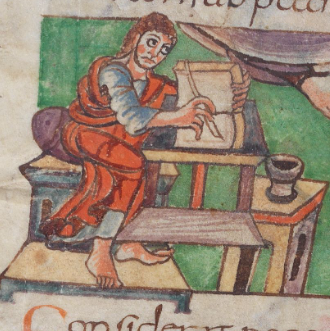
820-830 AD, Paris, FR

820-830 AD, Paris, FR
Conclusion
The iconographic sources found in Carolingian manuscripts provide a remarkably detailed picture of the variety of writing tables and lecterns that may have been in use during the Early Middle Ages. Although archaeological evidence for this furniture is scarce, the miniatures provide valuable insight into their form, function, and possible finishing. We see a clear distinction between lecterns — with central stands, possibly made of bronze — and writing desks, which occur in both high and low variants and were probably more commonly made of wood. Within these main groups, there are also several subtypes, with variations in legs, bases, decoration, and construction.
It is plausible that some designs originated from or were influenced by Byzantine and Eastern examples, which underlines the need to continue treating iconographic material critically. Nevertheless, it is plausible that certain forms, such as the openwork writing desks or the chest-like low pieces of furniture, were also used during the Carolingian period.
Literature
Von Katzenelnbogen, J. (z.d.). The Utrecht Psalter and its furnishings; Part II. https://johanninternational.blogspot.com/2016/10/the-utrecht-psalter-and-its-furnishings.html
Images
Fig. 1 – Utrecht Psalter, folio 21r
Universiteitsbibliotheek Utrecht. (ca. 820–830). Utrecht Psalter (ms. 32), fol. 21r [Manuscript]. Universiteitsbibliotheek Utrecht, Utrecht, Netherlands.
Fig. 2 – Evangeliarium van Godescalc, folio 1v
Bibliothèque nationale de France. (ca. 780–783). Evangeliarium van Godescalc, fol. 1v [Manuscript]. Bibliothèque nationale de France, Paris, France.
Fig. 3 – Utrecht Psalter, folio 45r
Universiteitsbibliotheek Utrecht. (ca. 820–830). Utrecht Psalter (ms. 32), fol. 45r [Manuscript]. Universiteitsbibliotheek Utrecht, Utrecht, Netherlands.
Fig. 4 – Evangeliarium van Godescalc, folio 2r
Bibliothèque nationale de France. (ca. 780–783). Evangeliarium van Godescalc, fol. 2r [Manuscript]. Bibliothèque nationale de France, Paris, France.
Fig. 5 – Bronzen standaard uit Iran (6e–7e eeuw)
The Metropolitan Museum of Art. (z.d.). Bronze standard (Object no. 34.107.1) [Bronzen standaard]. The Metropolitan Museum of Art, New York, NY, USA. Geraadpleegd op 14 mei 2025 van https://www.metmuseum.org/art/collection/search/324409
Fig. 6 – Khorasan zilver- en koper ingelegde bronzen standaard (12e–13e eeuw)
Bonhams. (2010). A Khorasan silver and copper-inlaid bronze lamp stand and oil lamp, Persia, late 12th/early 13th century [Veilingcatalogus, Lot 102, Auction 17854]. Bonhams. Geraadpleegd op 14 mei 2025 van https://www.bonhams.com/auction/17854/lot/102/a-khorasan-silver-and-copper-inlaid-bronze-lamp-stand-and-oil-lamp-persia-late-12th-early-13th-century4/
Fig. 7 – Utrecht Psalter, folio 68v
Universiteitsbibliotheek Utrecht. (ca. 820–830). Utrecht Psalter (ms. 32), fol. 68v [Manuscript]. Universiteitsbibliotheek Utrecht, Utrecht, Netherlands.
Fig. 8 – Utrecht Psalter, folio 90v
Universiteitsbibliotheek Utrecht. (ca. 820–830). Utrecht Psalter (ms. 32), fol. 90v [Manuscript]. Universiteitsbibliotheek Utrecht, Utrecht, Netherlands.
Fig. 9 – Stuttgart Psalter, folio 90v
Württembergische Landesbibliothek Stuttgart. (ca. 820–830). Stuttgart Psalter, fol. 90v [Manuscript]. Württembergische Landesbibliothek Stuttgart, Stuttgart, Germany.
Fig. 10 – Stuttgart Psalter, folio 164v
Württembergische Landesbibliothek Stuttgart. (ca. 820–830). Stuttgart Psalter, fol. 164v [Manuscript]. Württembergische Landesbibliothek Stuttgart, Stuttgart, Germany.
Fig. 11 – Stuttgart Psalter, folio 163r
Württembergische Landesbibliothek Stuttgart. (ca. 820–830). Stuttgart Psalter, fol. 163r [Manuscript]. Württembergische Landesbibliothek Stuttgart, Stuttgart, Germany.
Fig. 12 – Stuttgart Psalter, folio 90v
Württembergische Landesbibliothek Stuttgart. (ca. 820–830). Stuttgart Psalter, fol. 90v [Manuscript]. Württembergische Landesbibliothek Stuttgart, Stuttgart, Germany.
Fig. 13 – Utrecht Psalter, folio 1v
Universiteitsbibliotheek Utrecht. (ca. 820–830). Utrecht Psalter (ms. 32), fol. 1v [Manuscript]. Universiteitsbibliotheek Utrecht, Utrecht, Netherlands.
Fig. 14 – Stuttgart Psalter, folio 8r
Württembergische Landesbibliothek Stuttgart. (ca. 820–830). Stuttgart Psalter, fol. 8r [Manuscript]. Württembergische Landesbibliothek Stuttgart, Stuttgart, Germany.
Fig. 15 – Stuttgart Psalter, folio 1v
Württembergische Landesbibliothek Stuttgart. (ca. 820–830). Stuttgart Psalter, fol. 1v [Manuscript]. Württembergische Landesbibliothek Stuttgart, Stuttgart, Germany.