
Status: ongoing
Location: Carolingian empire
Period: 8th-10th century
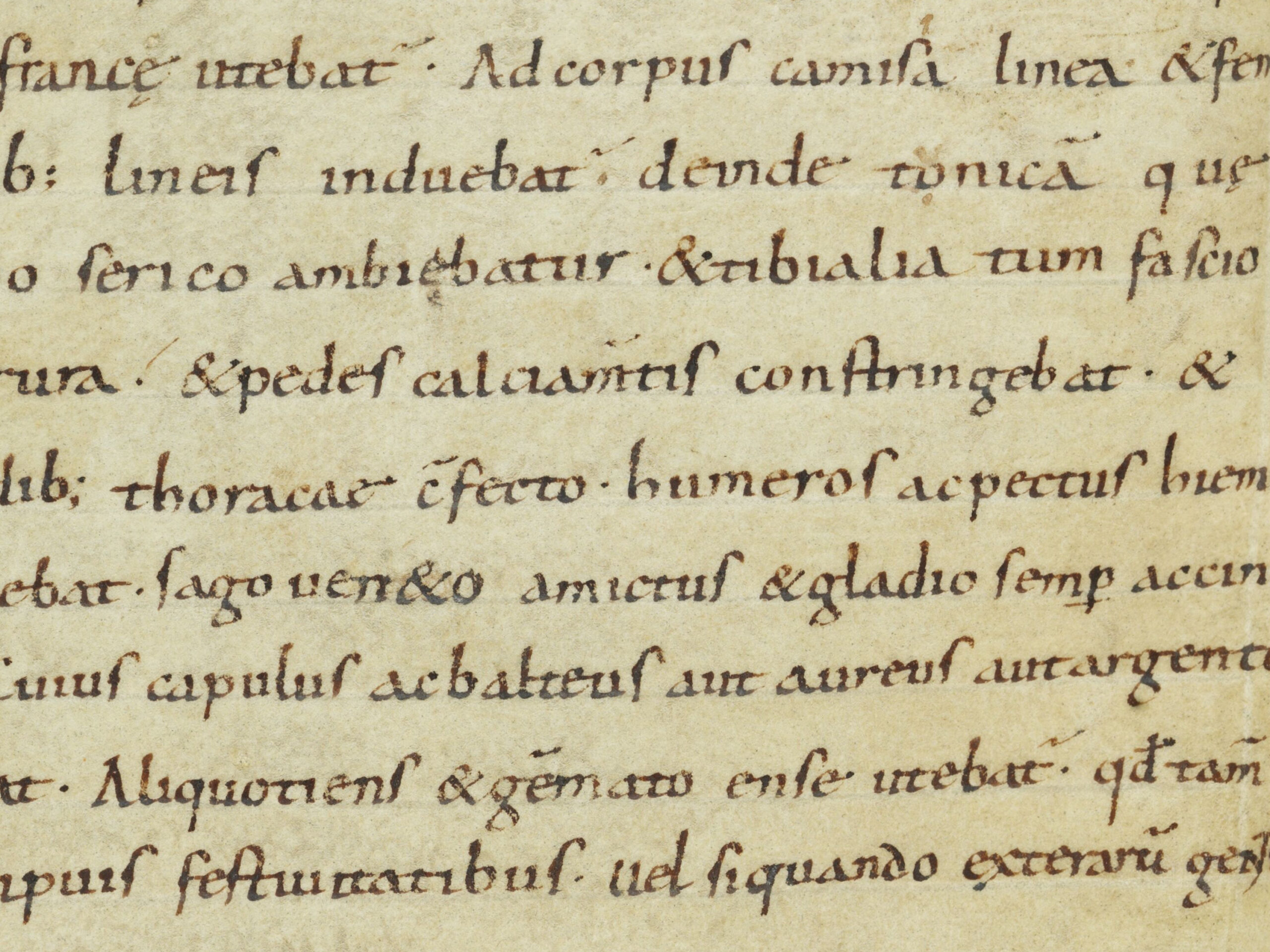

When reconstructing early medieval clothing, modern reenactors and living historians often begin with the archaeological record. Textile fragments, surviving garments, fittings, burial finds, and contemporary artistic representations provide valuable evidence for understanding how people in the Carolingian world dressed. Such evidence is indispensable, but it is not complete. Archaeology can demonstrate that a particular garment or textile existed, yet it can rarely tell us with certainty what that garment was called, how contemporaries distinguished it from similar items, or in which social and practical contexts it was worn.
This is where the written record becomes particularly important.
The Carolingian period produced a substantial body of Latin writing containing references to clothing and dress. Terms for garments, footwear, headwear, legwear, textiles, and other elements of dress occur in a wide variety of sources. They can be found in descriptions of individuals, administrative documents, inventories, monastic regulations, correspondence, legal texts, and other writings concerned with the practical organisation of contemporary society. Taken together, these references provide a different perspective on Carolingian clothing: not merely what survives archaeologically, but how people of the period described and classified the things they wore.
My current research focuses specifically on clothing terminology in Carolingian Latin manuscripts, with particular attention to the eighth and ninth centuries. The central aim is not simply to compile a list of Latin words for garments, but to investigate what those words actually meant within their contemporary contexts. This is an important distinction. A Latin term may appear to have an obvious modern equivalent, yet such an identification can be misleading if the semantic range of the medieval word does not correspond neatly with that of a modern garment.
The study therefore approaches clothing terminology as a problem of historical interpretation. For each term, I seek to establish its meaning through a combination of linguistic, textual, archaeological, and contextual evidence. Where possible, terms are compared across different manuscripts and genres in order to determine whether they possessed a relatively stable meaning or whether their significance changed according to context. Particular attention is given to distinctions between apparently similar garments, since differences in terminology may reflect differences in construction, length, material, function, social status, or manner of wear.
The research draws upon a broad selection of Carolingian manuscripts and texts rather than a single fixed corpus. Sources are selected according to their relevance, date, provenance, genre, and evidentiary value. This allows the research to remain open to additional manuscripts and textual references as the investigation develops, while also making it possible to compare terminology across different types of sources and social environments.
This requires a degree of source criticism. Not every Latin reference to clothing should automatically be treated as evidence for Carolingian dress. Biblical texts, psalters, and other works of a strongly liturgical or scriptural character have therefore been treated with caution and, where appropriate, excluded from the principal evidence. Such works frequently preserve passages transmitted from much earlier traditions, meaning that a clothing term occurring within them does not necessarily describe an item familiar to a Carolingian writer or reader. The presence of a word in a Carolingian manuscript is consequently not, by itself, sufficient evidence for its use or meaning in Carolingian society.
This distinction between the date of a manuscript and the date of the evidence it contains is particularly important. A ninth-century manuscript may preserve a text whose vocabulary ultimately derives from a much older source. Conversely, an administrative, legal, or monastic text may provide considerably stronger evidence for contemporary terminology precisely because it deals with the practical concerns of the society in which it was produced.
Monastic sources are especially valuable in this respect. Regulations concerning the clothing of monks and other religious communities often deal with garments in practical terms: what members of a community were permitted or required to possess, how garments were distributed, when they were replaced, and sometimes what distinctions existed between different members of the community. Such passages offer an opportunity to examine clothing terminology within a clearly defined social and institutional environment rather than in an abstract literary context.
The collected vocabulary is organised into functional categories, including areas such as legwear, body garments, outerwear, headwear, footwear, and accessories. These categories are analytical rather than necessarily reflecting Carolingian classifications themselves. They provide a means of comparing terms which modern readers might otherwise group together while still allowing their individual meanings to be examined separately.
Translation presents one of the principal difficulties of this research. A simple one-to-one translation can give the impression of greater certainty than the evidence permits. Terms such as tunica, camisia, bracae, feminalia, sagum, paenula, cucullus, and others cannot always be reduced to a single modern English or Dutch garment name without qualification. In some cases, the Latin term may cover a broader range of objects than its usual modern translation suggests; in others, two Latin terms may overlap considerably while nevertheless carrying different associations.
For this reason, the research distinguishes between the Latin term, its probable semantic range, and its possible modern equivalent. Rather than forcing every word into a definitive translation, the aim is to establish degrees of confidence. Where the evidence permits a relatively secure identification, this can be stated clearly. Where the evidence remains ambiguous, that ambiguity is itself recorded rather than concealed by an overly precise translation.
Context is therefore fundamental. A garment mentioned in a monastic rule may not have precisely the same significance as the same word used in a literary description of a nobleman. Similarly, a term appearing in an inventory may tell us something different from a term used to describe how a garment was worn. The meaning of a word must consequently be considered alongside the circumstances in which it occurs, the identity of the people involved, the type of document in which it appears, and, where possible, the material and archaeological evidence.
The ultimate purpose of this research is to bring the written and material records into closer dialogue. Neither source category should be treated as sufficient on its own. Archaeology can reveal the physical characteristics of clothing, while texts can reveal the vocabulary through which garments were understood and distinguished. When the two forms of evidence coincide, they can reinforce one another; when they do not, the discrepancy may reveal an important problem in our assumptions about medieval clothing.
For reenactors and living historians, this distinction is particularly significant. Modern reconstructions frequently depend upon translations of medieval terminology, and those translations can quietly influence the garments that are reproduced. If a medieval word is translated simply as “trousers,” “shirt,” “cloak,” or “hood,” it can create an apparently precise image which may not actually be supported by the original evidence. A more careful examination of the Latin terminology can therefore contribute to reconstructions that are not merely archaeologically plausible, but also linguistically and historically grounded.
This research is consequently concerned with a relatively narrow question: what did Carolingian writers call the clothes of their own world, and what can those words tell us about the garments themselves? By examining terminology within its textual, linguistic, and historical contexts, the study seeks to move beyond simple word-for-word translation and toward a more nuanced understanding of Carolingian dress.
The results will not necessarily produce a definitive dictionary of Carolingian clothing. Such certainty is rarely possible with early medieval evidence. Instead, the objective is to establish a documented framework in which individual terms can be evaluated according to the strength of the surviving evidence. In doing so, the research aims to provide a useful bridge between the written sources and the physical reconstruction of Carolingian clothing, while also identifying where our present understanding remains uncertain.