
Status: ongoing
Location: Dorestad (Wijk bij Duurstede, Netherlands)
Period: 8th-9th century
Current MNV: 150+ vessels
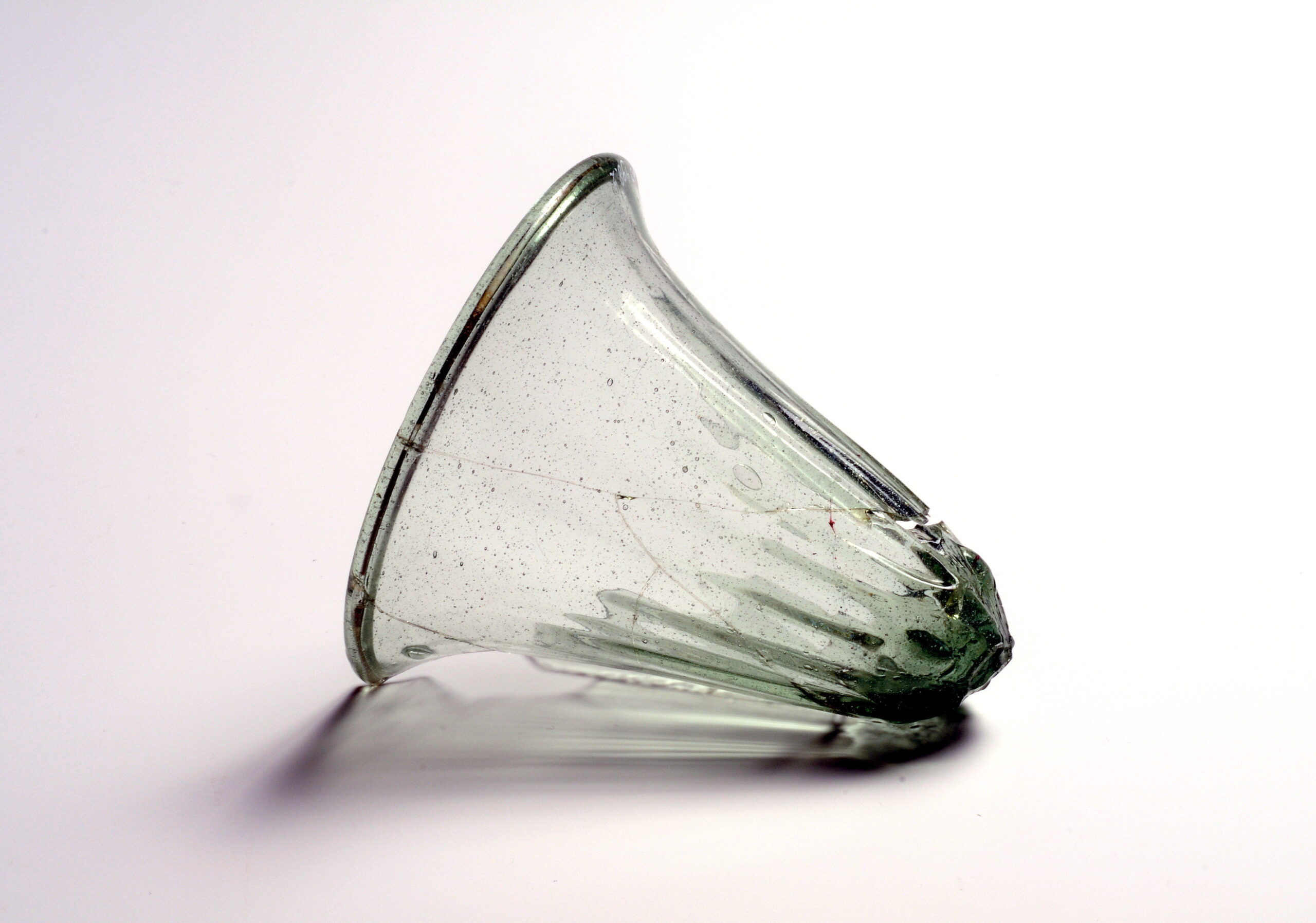
Findno. WD 498.2
A study of early medieval conical and funnel-shaped glass vessels from Wijk bij Duurstede
Among the many forms of early medieval glass found at Dorestad, the so-called funnel beakers occupy a particularly interesting position. These thin-walled, often conical vessels are characteristic of the Carolingian period and occur at several sites in north-western Europe. Despite their archaeological importance, however, the material from Dorestad has never, to my knowledge, been brought together into a single comprehensive corpus.
This project aims to change that.
I am currently compiling a corpus of all identifiable funnel-beaker fragments from Wijk bij Duurstede, with the ultimate goal of reconstructing the scale, variety and distribution of these vessels within the settlement of Dorestad.
The starting point: Dorestad
Dorestad, situated near modern-day Wijk bij Duurstede, was one of the most important trading settlements of the Carolingian world. During the eighth and ninth centuries it connected the Frankish hinterland with the North Sea and wider European trade networks.
The archaeological excavations carried out at Dorestad produced an enormous quantity of material, including a remarkable assemblage of imported and locally distributed glass vessels. Among these are numerous fragments of conical and funnel-shaped drinking vessels.
The material is, however, scattered across excavation reports, museum collections, archaeological archives and databases. Some objects were transferred from the former Rijksdienst voor het Oudheidkundig Bodemonderzoek (ROB) to the Rijksmuseum van Oudheden (RMO) in 1992. In some cases, the archaeological record survives while the physical object is currently difficult to locate, and consequently there is no readily available photographic documentation.
This makes the reconstruction of the original assemblage a challenging but potentially very rewarding task.
Building the corpus
The first stage of the project is the systematic recording of every identifiable funnel-beaker fragment from the excavations at Wijk bij Duurstede.
I have currently worked through the material from:
- Hoogstraat 0
- Hoogstraat I
- Hoogstraat II
- Hoogstraat III
- Hoogstraat IV
The corpus records as much information as possible for each fragment, including archaeological context, excavation number, collection or museum reference, vessel form, rim characteristics, estimated rim diameter, colour, manufacturing characteristics, decoration, preservation and available imagery.
Fragments are treated individually, while also being compared with other fragments in order to determine whether they may belong to the same vessel.
One of the main objectives is therefore to distinguish between the number of fragments and the minimum number of individual vessels represented by those fragments.
A surprisingly large assemblage
Even at this relatively early stage of the research, the results are striking.
The material currently documented from Hoogstraat 0 and Hoogstraat I–IV already represents a minimum of more than 150 individual funnel beakers.
This figure should not yet be regarded as a final estimate for Dorestad as a whole. The corpus is still being expanded, and many excavated areas and museum collections remain to be investigated. Nevertheless, it demonstrates that funnel-shaped glass vessels were present at Dorestad on a considerably larger scale than might be suggested by looking at individual finds or publications in isolation.
The eventual corpus may therefore provide an entirely different perspective on the role of glass drinking vessels within the settlement.
From fragments to vessels
One of the central questions of the project is how many individual vessels are actually represented in the archaeological record.
This is not as straightforward as simply counting fragments. A single vessel may produce numerous fragments, while fragments from different parts of the same vessel may have been recovered separately. Conversely, isolated rim fragments can sometimes provide particularly valuable evidence because rim diameter, profile and manufacturing characteristics can be used to distinguish vessel groups.
By systematically comparing characteristics such as:
- rim diameter;
- rim form;
- wall thickness;
- vessel profile;
- glass colour;
- manufacturing technique;
- decoration;
- fracture characteristics; and
- archaeological context,
it becomes possible to establish a minimum number of vessels (MNV) and, where the evidence permits, explore whether additional vessels may be represented.
This approach also makes it possible to quantify patterns that are difficult to see when studying individual objects.
What can the corpus tell us?
Once the corpus has been completed, the data can be used to investigate several broader questions.
For example:
How many funnel beakers are represented at Dorestad?
Which vessel types occur, and in what proportions?
What are the most common rim diameters?
Do particular vessel forms occur in particular excavation areas?
Can changes in vessel form or production be observed chronologically?
Are certain colours, manufacturing techniques or decorative features associated with particular contexts?
How does the Dorestad assemblage compare with other early medieval glass assemblages in north-western Europe?
The resulting dataset will therefore not simply be a catalogue of objects. It is intended to become a quantitative research tool for studying the production, circulation and use of early medieval glass.
Reconnecting the archaeological record
An important part of the project is also the attempt to reconnect objects with their original archaeological documentation.
Dorestad has been excavated over many decades, and its finds are now distributed between different institutions and collections. Some material is easily accessible; other objects are known only through excavation records, publications or old catalogue references.
The transfer of archaeological material from the ROB to the RMO in 1992 is particularly relevant to this research. I am currently investigating whether additional glass fragments from the Dorestad excavations remain in the RMO collections and, if so, whether these objects can be identified, documented and photographed.
Recovering this material would potentially allow previously separated pieces of evidence to be brought together again.
An open research project
The corpus is still very much a work in progress.
As an independent researcher with a particular interest in Carolingian archaeology and material culture, I am compiling the dataset from excavation reports, museum databases, archaeological publications, collection records and, where possible, direct examination of the objects themselves.
The intention is ultimately to make the results as transparent and useful as possible. Rather than focusing solely on spectacular complete vessels, the project deliberately includes the less glamorous material: small fragments, incomplete rims and objects whose archaeological context or present location is uncertain.
These fragments are important. Collectively, they can reveal patterns that individual objects cannot.
The long-term aim is to create a comprehensive, documented corpus of Dorestad’s funnel-shaped glass vessels, which can subsequently be used for statistical analysis, visualisation and comparison with other early medieval sites.
The research is ongoing, and the current figure of more than 150 vessels is only the beginning.